

Standing at the bottom of a deteriorating porch, every Chicago property owner eventually asks the same question: is this worth repairing, or do we need to start over? The answer matters because it affects not just your budget, but how the permitting process unfolds, how long the project takes, and how the finished structure will perform for the next several decades. Chicago's Building Rehabilitation Code provides specific guidance on this question, and understanding how it applies to your porch can save you from either an unnecessary full rebuild or, worse, a patch job that does not actually solve the problem.
How Chicago's Building Rehabilitation Code Approaches Porches
Chicago's Building Rehabilitation Code was designed to give property owners a more flexible, proportional path for improving existing buildings, rather than forcing every project to meet the full requirements of new construction. For porches, this framework matters because it generally distinguishes between repair work, which can often proceed under somewhat more flexible standards tied to the scope of work, and full replacement, which is treated essentially as new construction and must meet current porch code in full.
The practical effect is that the threshold between repair and replacement is not just a construction question, it is also a code question. A project that stays within the bounds of repair may be able to retain certain existing elements that would not be approved if you were building a new porch from scratch, while a project that crosses into replacement territory must meet every current requirement, including load capacity, railing dimensions, and connection details, regardless of what was there before. Understanding which category your project falls into shapes both the cost and the design from the very beginning.
Signs That Point Toward Repair
Repair is generally the right call when the issues are localized rather than systemic. If an inspection reveals isolated rot in a few joists, a couple of deteriorated posts, or a section of decking that has failed while the rest of the structure remains sound, replacing those specific components often restores the porch to a safe, code-compliant condition without triggering a full rebuild. Similarly, railing and stair issues that are confined to certain sections, rather than indicating a systemic design problem throughout the structure, are often addressable through targeted rebuilding.
The key factor is whether the overall frame, the connections to the building, and the foundation or footings remain sound. A porch where the main structural skeleton is solid, but individual components have worn out from decades of Chicago weather, is a strong candidate for repair. This approach typically costs less, takes less time, and disrupts the property less than a full teardown, which matters for landlords managing occupied units or homeowners who rely on the porch for daily access.
Signs That Point Toward Full Replacement
Full replacement becomes the right call when problems are widespread or involve the structure's fundamental bones. If multiple structural members throughout the porch show significant deterioration, if the connection between the porch and the building has failed or was never built correctly, or if the footings have settled or deteriorated to the point of compromising the whole structure, repairing individual pieces will not address the underlying problem. In these cases, a series of repairs often ends up costing more over time than a single well-executed replacement, while still leaving you with a structure that does not fully meet current standards.
Age is also a meaningful signal. Porches that are several decades old and have never been substantially rebuilt often have accumulated enough small issues, combined with original construction that predates current code, that a thorough inspection reveals replacement is the more sensible path even if no single problem looks catastrophic on its own. Additionally, if your porch was built without permits or does not match any record on file with the city, a full replacement built and permitted correctly from the start may be simpler than trying to retroactively document and repair an unknown structure.

The Inspection That Determines Your Path
Because the repair-versus-replacement decision has real consequences for cost, permitting, and timeline, it should start with a thorough professional assessment rather than a guess based on surface appearance. A proper inspection examines the framing members for rot, splitting, and undersizing, checks the condition and security of the connection to the building, evaluates the footings for settlement or deterioration, and reviews railings and stairs against current code requirements.
This inspection should also consider the porch's permit history where available, since a structure with no permit record on file may need to go through replacement-level review regardless of its physical condition, simply because there is no documentation that it was ever approved. A contractor experienced with Chicago porches will be able to look past the cosmetic condition, the paint, the surface wear, and assess what is actually happening structurally. This is the inspection that should drive your decision, not how the porch looks from the yard.
Cost Considerations for Each Path
Repair costs scale with the extent of the damage, and a project addressing a handful of deteriorated components is naturally less expensive than rebuilding an entire structure. However, it is worth being realistic about what repair actually costs when done correctly. Replacing structural members properly means matching lumber sizes to code requirements, using correct fasteners and connection hardware, and ensuring the repaired sections integrate properly with what remains. A repair that cuts corners to save money often fails inspection or, worse, fails structurally within a few years.
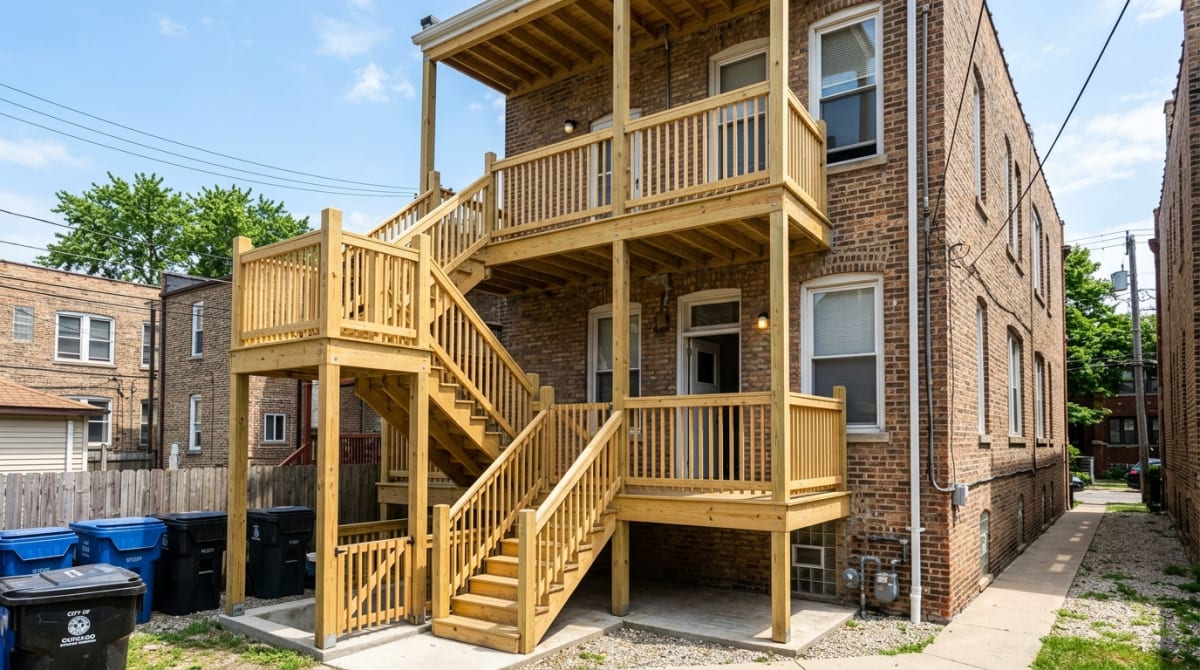
Full replacement costs more upfront because you are rebuilding the entire structure to current code, including framing, decking, railings, and stairs, often along with new footings. However, full replacement also resets the clock. A new porch built to current standards with quality materials should provide decades of reliable service without the recurring repair costs that an aging structure tends to generate. When property owners compare the lifetime cost of repeated repairs against a single well-built replacement, replacement frequently comes out ahead, especially for porches that are already showing multiple issues.
Permitting Differences Between Repair and Replacement
The permitting process differs depending on which path your project takes, which is another reason the inspection should come before you start planning the permit application. Repairs that are limited in scope may move through the permitting process somewhat more quickly because the review focuses on the specific components being addressed, though a permit is still required for structural work. Our guide to Chicago porch permit requirements covers the full process, including the dual approval that many porch projects require from both the Department of Buildings and your Alderman's office.
Full replacement is treated as new construction for permitting purposes, which means the entire structure must be reviewed against current porch code, including dimensions, load capacity, and material specifications. This typically requires more detailed drawings and may involve additional inspection stages compared to a targeted repair. Knowing which path you are on before you begin the permit process helps you assemble the right documentation from the start, rather than discovering partway through that your project needs to be reclassified.
Timeline Differences Between Repair and Replacement Projects
The time a porch project takes also differs significantly depending on which path you are on, and that timeline can matter just as much as cost for landlords with tenants relying on rear porch access or homeowners planning around a busy season. A targeted repair, addressing a handful of deteriorated joists, a section of decking, or a run of railing, generally moves faster because the scope is well-defined from the start and less of the structure needs to be rebuilt. Once the affected components are identified, ordering materials and scheduling the work tends to be straightforward, and the permit review for a limited repair often proceeds more quickly as well.
Full replacement takes longer for several reasons. The entire existing structure typically needs to be removed before rebuilding can begin, which adds demolition time and, for occupied buildings, requires careful planning so that residents are not left without porch access for an extended period. New footings, if required, need time to cure before framing can proceed, and the permit review for what amounts to new construction tends to involve more documentation and potentially more inspection stages. For landlords, this often means coordinating with tenants about temporary access arrangements during the rebuild, which is worth discussing honestly with your contractor early in the planning process so everyone's expectations are aligned.
Weather is another factor that affects both paths but hits full replacements harder. Concrete footings need temperatures within a certain range to cure properly, and framing work proceeds more slowly in extreme cold or wet conditions. Planning a full replacement for the warmer months, when possible, helps keep the project on schedule, while a smaller repair has more flexibility to be scheduled around weather windows since less of the work depends on concrete curing times.
Making the Decision With Confidence
The repair-versus-replacement decision ultimately comes down to an honest assessment of the structure's bones. If the frame, connections, and foundation are sound and the issues are localized, repair is often the more economical and less disruptive choice, and done correctly it produces a structure that meets code and performs well for years. If the problems are widespread, involve the structural connections, or the porch's history and condition raise broader questions, full replacement, while a bigger investment upfront, often delivers better value over time and gives you a structure built entirely to current standards.
Whichever direction your porch needs to go, the most important step is getting an honest, thorough assessment from someone who knows what Chicago's porch code actually requires and can see past surface-level wear to the structure underneath. Contact us for a consultation and we will inspect your porch, walk you through what we find, and help you choose the path that makes the most sense for your home and your budget.
Related Posts
- Chicago Porch Permit Requirements: A Step-by-Step Guide for Homeowners and Landlords
- 5 Common Porch Violations Chicago Property Owners Face and How to Fix Them
- Building a Code-Compliant Porch in Chicago: Material and Design Requirements for 2026
Reviewed by the Budget Construction Company Editorial Team
Budget Construction Company has served Chicago homeowners since 1976. Project costs and requirements vary by property, scope, and municipality.