

If you own an aging Chicago home that needs more than cosmetic updates, you've probably wondered: how much does a complete gut renovation actually cost? The answer matters, because it shapes whether you renovate now, wait and save longer, or explore more targeted remodeling approaches. Chicago's unique housing stock—thousands of pre-1950 homes with aging systems, outdated layouts, and deferred maintenance—means gut renovations here cost differently than in newer housing markets. In this guide, we'll break down exactly what Chicago homeowners paid for full gut renovations in 2025 and what you should budget for 2026.
Understanding What "Gut Renovation" Really Means
Before we dive into costs, let's clarify terminology. A gut renovation means removing most or all non-structural interior elements—walls, flooring, mechanicals, plumbing, electrical, fixtures, and finishes—and rebuilding from the studs and concrete. It's not a cosmetic refresh. It's not a kitchen and bathroom update. A true gut renovation touches every system in your home and leaves you essentially rebuilding the entire interior. In Chicago, gut renovations often include addressing issues that cosmetic work can't touch: outdated electrical systems that don't meet modern code, knob-and-tube wiring that insurance companies refuse to cover, cast iron plumbing that's deteriorating, and structural issues that only become apparent once walls come down.
The scope of a gut renovation varies significantly based on your home's condition, size, and neighborhood. A 1,500-square-foot bungalow in Portage Park faces different challenges and costs than a 3,500-square-foot greystone in Lincoln Park. A home that's been neglected for twenty years requires more structural work than one that's had regular maintenance. Understanding these variables helps you anticipate where your project's costs will land.
Hard Numbers: 2026 Gut Renovation Costs in Chicago
Based on completed projects in the Chicago area during 2025, homeowners budgeted between $150 and $350 per square foot for full gut renovations. This range accounts for variation in material choices, finish levels, and whether you're addressing significant structural work. For a typical 2,000-square-foot Chicago single-family home, that translates to a total project cost between $300,000 and $700,000. A smaller 1,500-square-foot bungalow might run $225,000 to $525,000. A larger 3,000-square-foot home could exceed $1,050,000 depending on decisions made throughout the project.
These numbers aren't pulling from national averages or big construction blogs written in Texas. They're based on actual projects completed by Chicago contractors working in neighborhoods like Rogers Park, Evanston, Lincoln Square, and Portage Park. The variation is significant enough that understanding what drives costs upward helps you make informed decisions about your specific project. A fully gutted and beautifully renovated home at the lower end of this range ($150/sq ft) prioritizes efficiency and value. A higher-end gut renovation ($300+ per square foot) includes premium finishes, custom details, and possibly additional square footage added during the project. Most Chicago homeowners land somewhere in the $200 to $250 per square foot range, which represents quality work with thoughtful material selection and updated systems throughout.
Breaking Down Where Your Money Goes
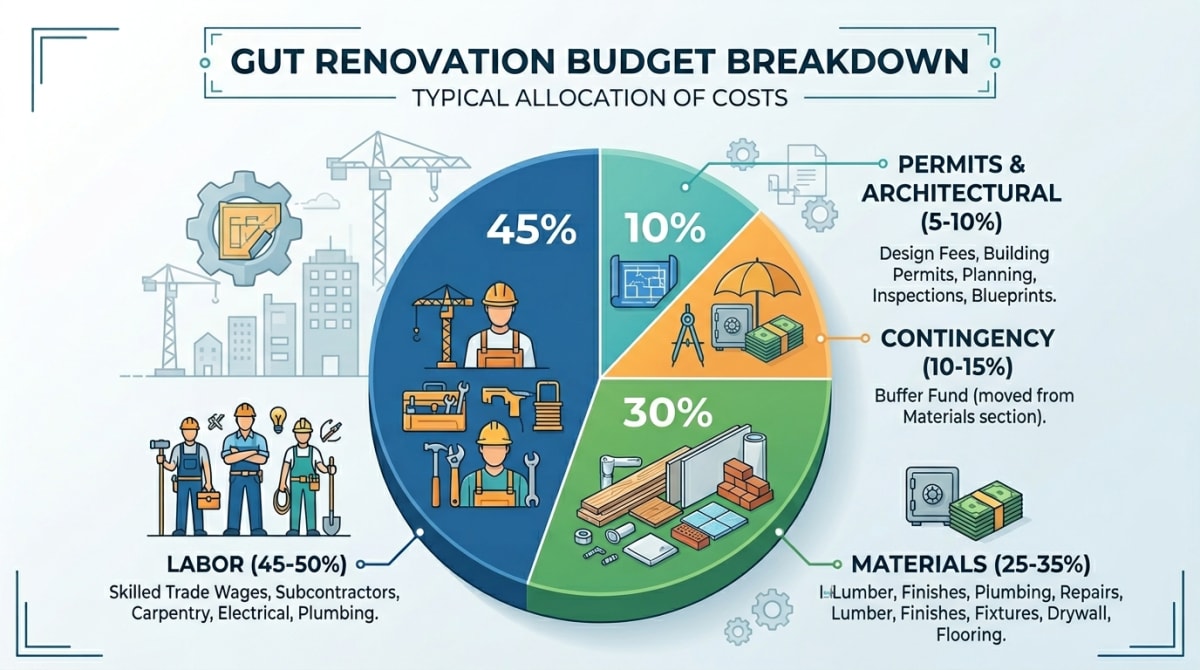
The single largest expense in any gut renovation is labor, which typically represents forty to fifty percent of your total project cost. In Chicago's competitive labor market, skilled trades command premium rates, especially for the experienced crews who understand older homes and local building codes. Electricians, plumbers, HVAC specialists, and structural workers in the Chicago area earn significantly more than counterparts in smaller Midwest markets. A complex plumbing installation in a pre-1950 home with challenging access points costs more than straightforward work in a newer home with conventional layout and simple routing options.
Materials represent the second-largest cost category, typically running twenty-five to thirty-five percent of total project budget. This includes everything: drywall and framing lumber, electrical and plumbing supplies, HVAC equipment, flooring, tile, paint, lighting fixtures, cabinetry, countertops, and appliances. Here's where your specific choices matter enormously. A kitchen with builder-grade cabinetry and laminate countertops costs a fraction of custom cabinetry with marble or quartz counters. Ceramic tile flooring runs significantly less than natural stone. Choosing where to invest in quality and where to prioritize value affects your final material costs dramatically. Chicago material costs are slightly higher than smaller Midwest cities but lower than coastal markets, primarily due to shipping distances and local availability.
Permits, inspections, and architectural services typically consume five to ten percent of your renovation budget. Chicago's permit process is thorough and necessary—skipping permits creates far bigger problems down the road. Building permits, electrical permits, plumbing permits, and mechanical permits each have fees based on project scope and estimated cost. Inspections happen at framing, rough electrical, rough plumbing, mechanical, and final stages. If your home is in a historic district like Lincoln Park or Oak Park, you may need additional historic preservation approvals that add both time and cost. Architectural or design services vary widely. Some homeowners work directly with their contractor and a designer. Others hire independent architects. This cost ranges from five percent of budget for contractor-provided design to fifteen percent for independent architectural services.
Hidden costs and contingency reserves represent the remaining ten to fifteen percent—and this is where many homeowners find themselves scrambling. When walls come down in a ninety-year-old Chicago bungalow, surprises emerge. Water damage in structural framing requires replacement lumber. Outdated electrical systems need more extensive replacement than anticipated. Foundation issues discovered during demo need addressing. A professional contractor includes contingency reserves—typically ten to fifteen percent of total estimated cost—to handle these inevitable surprises without derailing the entire project. Homeowners who don't budget contingency end up choosing between stopping work, tapping home equity lines, or making hasty financial decisions that undermine the renovation's value.

What Factors Push Costs Higher?
Several Chicago-specific variables can push your gut renovation toward the higher end of the cost spectrum. If your home is in a historic district, expect additional costs for historic preservation documentation, special permit approvals, and potentially requirements to match original materials or architectural details. If your property sits on a small city lot like many Chicago homes do, structural work to strengthen foundations or resolve settling issues adds significant cost. If your neighborhood requires off-street parking or has strict HOA requirements, these may add to overall project complexity.
Accessibility features push costs up but often add long-term value. A wider main-floor bathroom to accommodate aging in place, zero-threshold shower entry, lever hardware throughout, and accessible kitchen counters all add cost compared to standard layouts. But if you're planning to age in your Chicago home, these features pay dividends in function and eventual resale value. Similarly, energy-efficient HVAC systems, quality insulation, and upgraded windows cost more upfront than basic code-compliant alternatives but reduce operating costs year after year.
The condition of your existing structure matters significantly. A home with solid bones, addressed foundation issues, and intact roof systems requires less structural work than one with water damage, settling issues, and failing systems. A 1950s-era home requiring mostly cosmetic updating costs less to gut than an 1890s Victorian where hidden structural issues emerge during demo. This is why professional home inspections before committing to a gut renovation provide invaluable clarity. They help you anticipate which issues will surface and budget accordingly rather than discovering expensive problems mid-project.
Material Cost Variables
Your specific material choices dramatically affect total project costs, even within a single cost tier. A kitchen renovation at the mid-range price point might include semi-custom cabinetry, quartz countertops, and mid-range appliances. You could reduce costs by choosing builder-grade cabinetry and laminate counters, or increase them by selecting custom cabinetry and marble surfaces. Flooring choice ranges from mid-range luxury vinyl plank at $3-5 per square foot installed to high-end hardwood at $8-12 per square foot or natural stone at $10-15 per square foot. Bathroom selections range similarly from standard tile and builder-grade fixtures to custom tilework and high-end finishes.
Chicago's climate affects material durability and selection strategy. Hardwood flooring in Chicago homes experiences wider temperature and humidity swings than temperate climates, making quality installation and proper acclimation critical. Bathroom materials must handle freeze-thaw cycles and humidity. Exterior finishes endure lake-effect weather patterns. Selecting materials that perform well in Chicago's climate prevents costly repairs and replacements in future years. Sometimes paying slightly more for climate-appropriate materials saves money in the long run.
2026 Price Increases and Market Factors
Material costs in early 2026 remain elevated compared to pre-pandemic levels, though they've stabilized somewhat after 2023-2024 volatility. Steel and lumber prices affect framing costs. Copper prices directly impact electrical and plumbing material costs. Appliance availability and pricing fluctuate based on supply chain conditions. Most Chicago contractors report that material costs have plateaued, though labor costs continue climbing as skilled trade demand remains high and apprenticeship programs struggle to produce enough qualified workers.
Chicago's labor market specifically is strong, meaning the contractors who take on gut renovations have plenty of work and less incentive to discount rates aggressively. You won't find rock-bottom labor pricing like you might in markets with excess contractor capacity. What you get instead is reliability, quality, and contractors who understand Chicago code and older homes. This costs more money than hiring an inexperienced crew at discount rates, but the quality difference justifies the expense.
Making Gut Renovation Costs Work for Your Budget
If a complete gut renovation exceeds your current budget, several alternatives deserve consideration. A phased renovation addresses the most critical systems and highest-impact spaces first—often prioritizing the kitchen and primary bathroom while updating electrical and HVAC systems—then tackling remaining spaces over multiple years. This spreads costs across several years and allows you to live in your home during the project rather than temporarily relocating. The trade-off is that phased work typically costs more per square foot than a complete gut because crews mobilize multiple times and project efficiency suffers.
A targeted remodeling approach focuses on the spaces and systems that have the biggest impact on daily living and home value: kitchen, primary bathroom, HVAC, electrical, and plumbing updates. This costs substantially less than a complete gut—typically $100,000 to $250,000 for a 2,000-square-foot home—and addresses the most critical functionality issues. Secondary bedrooms, bonus rooms, and finished basement spaces remain as-is. Homes renovated this way function beautifully for decades while other spaces retain original character, which some homeowners actually prefer.

Financing Your Gut Renovation
Most Chicago homeowners finance gut renovations through home equity lines of credit, home equity loans, or construction loans. Home equity products use your existing home value and equity as collateral, typically at lower rates than unsecured loans but with your home at risk if you default. Construction loans disburse funds as work progresses, protecting you against paying for incomplete work. Many contractors and homeowners use a combination: a construction loan during renovation that converts to a standard mortgage once the project completes. If you're planning a gut renovation, meeting with a mortgage broker early—before signing contractor agreements—helps you understand your financing options and capacity.
Working with an experienced gut renovation contractor matters not just for quality but for budget management. A contractor accustomed to Chicago's older homes and complex projects will catch issues during initial assessment rather than discovering them mid-project. A contractor who understands phased permitting, manages contingency reserves professionally, and communicates budget changes clearly helps you control costs. Conversely, an inexperienced contractor who underestimates project scope leaves you facing mid-project cost overruns and scrambling for additional financing.
Making Your Gut Renovation Decision
A complete gut renovation represents a significant financial commitment, but for the right Chicago home and the right homeowner, it creates lasting value and enjoyment. A gut-renovated home built on solid bones and modernized systems can serve your family for decades with minimal major repair costs. The appeal of living in a vintage Chicago neighborhood—the architecture, the established trees, the walkable community—combined with modern efficiency, functionality, and code-compliant systems represents something you can't buy new in most Chicago neighborhoods.
If you're considering a gut renovation and want to discuss your home's specific condition, identify which systems need immediate attention, and understand realistic budget ranges for your project, Budget Construction Company has completed dozens of full gut renovations in Chicago neighborhoods. We understand the cost variables that affect Chicago projects specifically and can help you make informed decisions about phasing, material selection, and design choices that align with your budget and goals. Contact us for a consultation or request a free estimate to discuss your gut renovation vision and get accurate numbers for your specific property.
Related Posts
- How Long Does a Full Gut Renovation Take in Chicago? Realistic Timelines for 2026
- Gut Renovating a Historic Chicago Home: Preserving Character While Meeting Modern Building Codes
- Gut Renovation vs. Partial Remodel: Which Is Right for Your Chicago Home?
Reviewed by the Budget Construction Company Editorial Team
Budget Construction Company has served Chicago homeowners since 1976. Project costs and requirements vary by property, scope, and municipality.