

Renovating a high-rise condo in neighborhoods like River North, Streeterville, the Gold Coast, or Lakeview involves a layer of coordination that single-family homeowners never face. The construction work itself may be straightforward, but getting materials in, debris out, and crews working within building rules is where high-rise projects succeed or stall. Before a single wall comes down, your contractor must coordinate freight elevator access, approved work hours, delivery protocols, dust containment, and neighbor notification with building management. Understanding these logistics up front protects your timeline and your relationship with the building. Here is what cannot be ignored when renovating a Chicago high-rise.
Freight Elevator Reservations Drive the Schedule
In a high-rise, the freight elevator is the lifeline of your entire project, and it is a shared resource. Every load of materials in and every load of debris out moves through it, which means your contractor must reserve it in advance, often in limited time blocks and sometimes for a fee or deposit. Many buildings allow freight use only during specific hours and not at all on weekends or holidays, and popular buildings book the elevator across multiple renovations at once.
This single constraint shapes the whole schedule. A project that would take three weeks in a house can stretch longer simply because deliveries and debris removal must be staged around elevator availability. Experienced high-rise contractors plan material orders to arrive in coordinated batches rather than piecemeal, reserve elevator time well ahead, and sequence demolition debris removal so the unit is not clogged with material waiting for a slot. Ask any contractor how they handle freight scheduling before hiring, because mishandling it is the most common source of high-rise delays.
Construction Hours and Noise Restrictions
High-rise associations restrict when noisy work can happen, because dozens of households share walls and floors. Typical rules permit construction only on weekdays during business hours, often something like 9 a.m. to 5 p.m., with tighter limits on the loudest activities like demolition, jackhammering, and core drilling. Some buildings prohibit noisy work entirely during certain hours or require advance notice to neighbors before high-impact days.
These limits compress the working day and extend the calendar. A crew that could work ten hours in a house may be limited to six or seven productive hours in a high-rise, which adds labor days to the schedule and cost to the budget. Building this reality into your timeline from the start prevents frustration. Our Chicago condo renovation timeline guide breaks down how these constraints translate into realistic project durations.
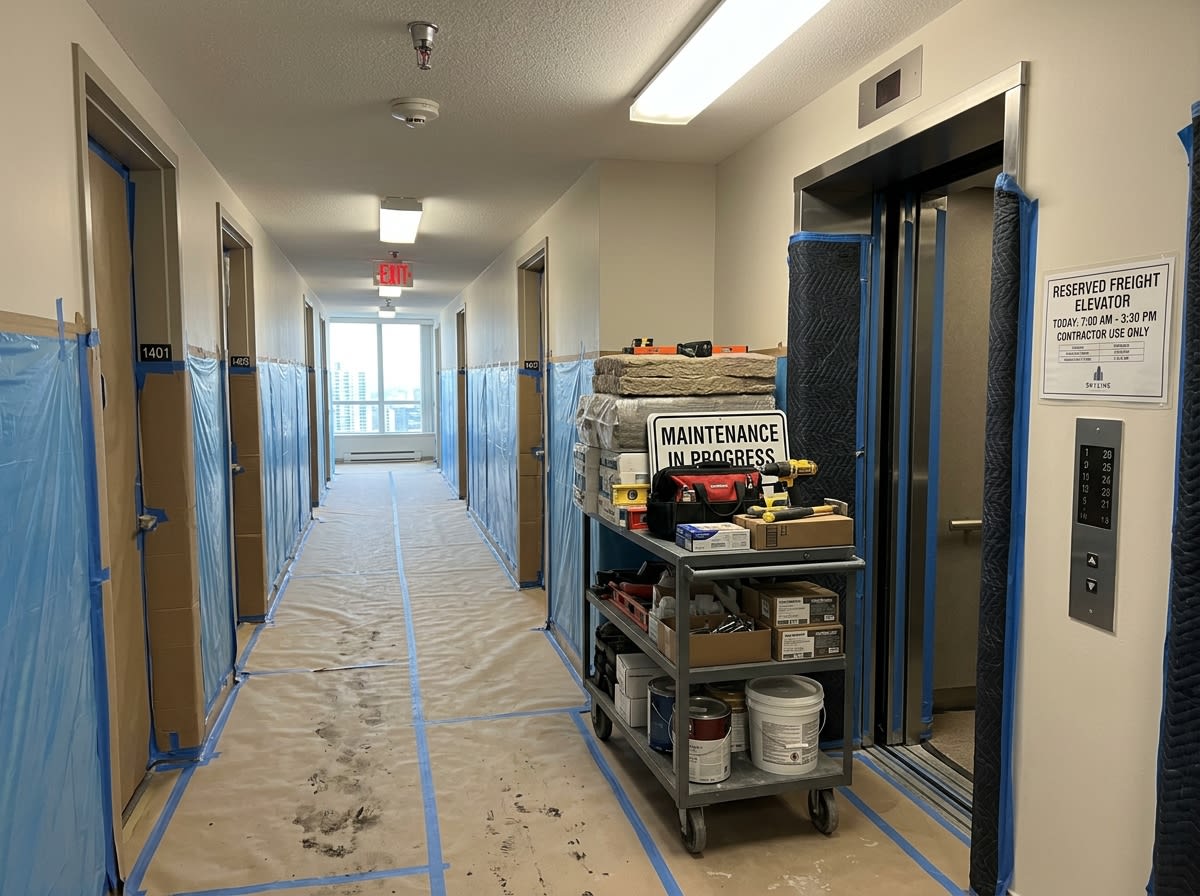
Material Delivery and Debris Removal Protocols
Moving materials and debris through a residential tower follows strict protocols designed to protect common areas and other residents. Most buildings require that deliveries be scheduled, that crews use only designated service entrances and the freight elevator, and that hallways, lobby floors, and elevator interiors be protected with padding and coverings. Debris usually cannot sit in common areas and often must be hauled out the same day rather than accumulating in the unit.
Large or heavy items present their own challenge. Oversized cabinetry, stone slabs, bathtubs, and appliances must fit the freight elevator and clear the path to the unit, and in rare cases an item simply will not fit and must be substituted or brought in pieces. A walkthrough measuring the freight elevator and the route from the loading area to the unit before ordering materials prevents the expensive problem of a delivered item that cannot be moved into place.
Dust Containment and Protecting Neighbors
Because high-rise units share ventilation considerations and close quarters, dust and air-quality control are taken seriously. Buildings commonly require containment measures such as sealing the unit's entry, protecting or temporarily managing HVAC returns so dust does not travel through shared systems, and using dust barriers during demolition. Tracking dust into hallways or letting it migrate to neighboring units generates complaints and can trigger building penalties.
Protecting neighbors goes beyond dust. Considerate scheduling of the loudest work, advance notice for high-impact days, and keeping common areas clean all preserve goodwill with the people you live near. In a high-rise, your renovation is visible and audible to many households, and a contractor who manages that relationship well makes the entire project smoother. The buildings that are strictest about these protocols are usually the ones where good contractors are most valued.

Insurance, Approvals, and Building Documentation
Before work begins, high-rise buildings require documentation that protects the association and other owners. This typically includes proof of contractor general liability and workers' compensation insurance, often with the association named as an additional insured, a signed alteration agreement defining the approved scope, and sometimes a refundable damage deposit. Work touching plumbing, electrical, or structure may require licensed trades and engineer review, and the city permit process applies on top of the building's own approvals.
Gathering this paperwork takes time, so it should begin early. A contractor experienced in Chicago high-rises will already know how to assemble insurance certificates, complete alteration agreements, and coordinate with property management, which prevents the project from being held at the starting line. Confirming all approvals are in hand before scheduling demolition avoids the costly situation of a crew arriving only to be turned away by building staff.
Coordinating Trades in a Vertical Job Site
A high-rise renovation is a more complex coordination problem than a house, because every trade and every delivery competes for the same constrained access. In a single-family home, a plumber can pull up to the curb and carry materials in through the front door at any hour. In a high-rise, that same plumber works within reserved elevator windows, approved hours, and a single protected path to the unit. Multiply that across electricians, tile setters, cabinet installers, and material deliveries, and the value of tight scheduling becomes clear.
This is why sequencing matters so much in a tower. An experienced high-rise contractor stages the work so trades flow in the right order without colliding, schedules deliveries to match elevator availability, and avoids the idle days that occur when materials are stuck waiting for access. Poor coordination shows up as a job site where crews wait on each other or on materials, quietly adding labor days and cost. Asking a prospective contractor how they coordinate trades and deliveries in high-rise conditions reveals quickly whether they understand the environment.
Choosing a Contractor Built for High-Rise Work
Not every excellent contractor is suited to high-rise work, because the skills that matter most extend beyond construction. The right team has a track record in towers, an established relationship with how building management operates, and the administrative discipline to handle insurance certificates, alteration agreements, and elevator reservations without prompting. They know how to protect common areas, contain dust, and keep neighbors and building staff on their side, all of which protect you from complaints and penalties.
When evaluating contractors, ask specifically about their high-rise experience, request examples of similar buildings they have worked in, and confirm they carry the insurance your building requires. A contractor who treats the building's rules as central to the job, communicates proactively with management, and plans logistics in detail will deliver a far smoother project than one who is technically skilled but unfamiliar with tower constraints. In a high-rise, that operational competence is not a nice-to-have, it is the difference between a project that finishes on schedule and one that stalls.
Communicating With Building Management and Neighbors
A high-rise renovation succeeds not only through good construction but through good communication, because you are working inside a community of households who will notice the disruption. Establishing a clear line of communication with building management from the start sets the tone. Management can tell you the building's specific rules, available freight windows, and required documentation, and keeping them informed throughout signals that you respect the building and its processes. A property manager who trusts your contractor is far more accommodating than one fielding complaints about an uncoordinated crew.
Neighbors deserve consideration too, and a small amount of courtesy prevents most friction. Letting adjacent units know when the loudest work is scheduled, keeping common areas clean, and ensuring crews are respectful in shared spaces all preserve goodwill during a process that inevitably causes some inconvenience. The owners who have the smoothest high-rise renovations are usually those who treat the building's staff and residents as partners rather than obstacles. That relationship pays off when you need a favor on scheduling or a bit of flexibility, and it makes living in the building comfortable long after the work is done.
Planning for the Unexpected in a Tower
Even the best-coordinated high-rise project encounters surprises, and planning for them keeps small issues from becoming major delays. A freight elevator can go out of service, a delivery can be turned away for a paperwork gap, or building staff can flag a protocol you did not anticipate. Because access is the constraint that governs everything in a tower, a single missed elevator window can ripple through the schedule. Building modest buffers into your timeline and budget absorbs these events rather than letting them throw the project off course.
The contractors who handle towers well anticipate these possibilities and have contingency plans, such as alternative delivery scheduling and close communication with management to resolve issues quickly. As an owner, the best preparation is to choose that kind of experienced team, confirm all approvals and documentation before demolition, and stay in regular contact so problems surface early. A high-rise renovation rarely goes perfectly start to finish, but one that is well planned and well communicated handles the bumps smoothly and still reaches the finish on a reasonable schedule.
Planning a Smooth High-Rise Renovation
A successful high-rise renovation depends as much on logistics and coordination as on craftsmanship. Freight scheduling, work-hour limits, delivery protocols, dust control, and building documentation all need to be managed in parallel with the actual construction. The contractors who excel at high-rise work are the ones who treat these constraints as a core part of the job rather than an afterthought. If you are planning a renovation in a Chicago high-rise and want a team that understands how to work within your building's rules, contact us for a consultation and we will help you map out the logistics before the first delivery is scheduled.
Related Posts
- Chicago Condo Renovation Timeline: How Long Does Each Project Actually Take
- Chicago Condo Renovation Costs 2026: Complete Budget Guide by Project Type
- What to Do When Your HOA Denies Your Renovation Request in Chicago
Reviewed by the Budget Construction Company Editorial Team
Budget Construction Company has served Chicago homeowners since 1976. Project costs and requirements vary by property, scope, and municipality.