
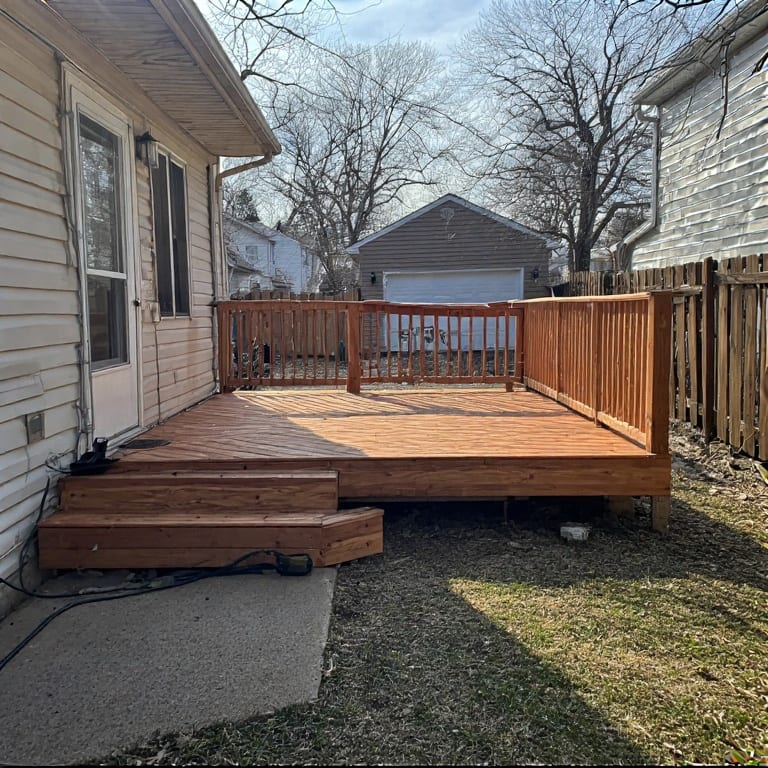
The best design begins with activities and movement rather than a target square footage.
Decide What the Deck Must Do
List the primary uses in order. A household that wants outdoor dining needs a stable table zone and room to pull chairs back. A family focused on entertaining may prioritize built-in seating. Someone who grills frequently needs a safe cooking location and a clear route to the kitchen.
Trying to fit every feature usually creates cramped circulation. Choose one primary function and one or two supporting functions.
Preserve a Clear Path
Map movement from the house to the yard, garage, gate, trash area, and parking. Avoid forcing people through a dining group or around an open grill to reach another part of the property.
On a narrow lot, placing circulation along one edge often creates a larger uninterrupted activity zone. Stairs should land where they support the yard layout instead of dividing it.
Use Built-In Seating Carefully
Benches can reduce furniture clutter and create storage, but they should not interfere with required guards or trap water against the structure. Removable cushions and ventilated storage improve durability.
An L-shaped bench can define a conversation area while leaving the center open. A narrow ledge or drink rail may be more useful than a full-depth counter in very limited spaces.
Combine Deck and Ground-Level Space
The deck does not need to cover the entire yard. A smaller landing-level deck can connect the house to a patio, lawn, or planting area. This often creates more visual depth and gives each activity an appropriate surface.
Decks are useful where elevation or door access matters. Patios are effective for heavy furniture, fire features where permitted, and grade-level dining. A hybrid design may deliver more function at a better cost than one oversized platform.
Add Privacy Without Closing the Yard
Tall solid walls can make a small yard feel confined and may face wind or zoning constraints. Consider partial screens, open slats, trellises, layered planting, or strategically placed panels.
Study views from neighboring windows and from seated positions. Privacy may only be needed in one direction or at one corner.
Plan Storage From the Beginning
Outdoor cushions, gardening tools, toys, and grilling supplies quickly overwhelm a small deck. Built-in bench storage, space beneath accessible portions of an elevated deck, and narrow weather-resistant cabinets can keep the surface clear.
Maintain ventilation and access for structural inspection. Do not permanently conceal posts, connections, drains, or areas that need maintenance.
Make Lighting Earn Its Space
Use a few purposeful layers: door lighting for safe entry, stair and path lighting for movement, and warm ambient lighting for seating. Shield fixtures to reduce glare into neighboring properties.
Plan wiring before boards and finishes are installed. Surface-mounted extension cords are not a durable lighting strategy.
Choose Materials for Chicago Weather
Small decks receive concentrated traffic, furniture movement, snow storage, and grilling wear. Pressure-treated wood controls initial cost but requires consistent maintenance. Composite materials reduce staining and sealing work but still need cleaning and a correctly built frame.
Our wood versus composite durability guide and Chicago deck cost guide explain the tradeoffs.
Avoid These Small-Deck Mistakes
- Making the deck too deep for the yard
- Ignoring gate, garage, and trash circulation
- Adding wide stairs that consume usable space
- Placing a grill in the main path
- Building privacy screens without considering wind
- Eliminating access to structural components
- Forgetting where snow will be moved
- Choosing furniture before measuring clearances
Measure With Real Furniture
Mark the proposed deck with tape, stakes, or temporary furniture before finalizing the plan. Pull out chairs, open the grill, walk the paths, and simulate the number of people likely to use the space.
A dimension that looks adequate on paper may feel tight in use. Testing the layout is inexpensive and often leads to a better stair location or slightly different footprint.
Permits and Site Constraints
Property lines, setbacks, easements, utility locations, height, and attachment details can affect the design. Verify current requirements before assuming the entire available yard can be built on. Chicago projects should begin with the Department of Buildings and address-specific zoning review when needed.
Budget Construction Company designs and builds custom Chicago decks. Request a design consultation to fit useful outdoor living into your actual yard and budget.
Reviewed by the Budget Construction Company Editorial Team
Budget Construction Company has served Chicago homeowners since 1976. Project costs and requirements vary by property, scope, and municipality.